Over the last 12 months, I've thought and read a lot about the Constructivist learning theory. I feel this theory sits well with nursing education, undergraduate and post graduate.
Prior to my lab session this week, where my job description is to 'instruct on practical skills,' I thought about how and if my lab aligns with this theory.
To start with my job description doesn't. In viewing myself as a facilitator to students learning, rather than a teacher, it's made it easier to create the environments to allow them to construct their own knowledge and lead their own experience.
In Lefoe article "Creating Constructivist Learning environments on the web: the challenge in higher education (1998)" the basic idea of the constructive learning environment is simply put that "at a minimum a learning environment contains; a learner and a setting or space wherein the learner acts, using tools and devices, collecting and interpreting information, interacting perhaps with others, etc."
So where am I in that? Not up the front barking instructions and imparting knowledge. My job is to set that environment to be engaging to allow the leaner to experience and build upon that. And I'm more there as another resource and sounding board?
So now I'm putting more thought into what the students see when they enter the lab. How I can place the tools they'll use in such a way that it invokes thought and conversation. I did a little experiment. I'm meant to teach and demonstrate priming intravenous infusions. I had one set up and ready, and another next to in a packet not done. I sent one group to that set up. Gave them 10 minutes to look/touch/experiment with the set up and set the 2nd one up. The other group I did the old fashion show and tell. After that, I gave each group a new set and allowed them to set up and prime the new line.
The group that had no instruction, but learnt by touching/experimenting with trial and error, where far more adapt at the skill. They also appeared to enjoy themselves more and were steps ahead with having already previously made errors and learnt how to avoid them.
So note to self...less talk, more action.
Wednesday, 12 March 2014

Tuesday, 11 March 2014
Mapping my mind
Having listened and watched a slide show on Curriculum Design: The big picture I set about making a mind map for a unit I had an idea about. This medication calculation unit, is really a subject within an established unit. It's problematic though, as it's almost squashed into an already busy unit because it's something that 'has to be done.' The thing is, it doesn't just have to be done, it has to be assessed and the pass mark is 100% and that is required by the nurses professional registration body. I think it needs more focus.
So full of enthusiasm I looked at the basic mind map and set about making mine, really focusing on the constructive alignment with the other practical unit.
Here's the example framework:

Here's my attempt:
 So on review of my own work, what's included?
Although I've given myself a high five for working through the online mind map software (with minimal expletives).
So full of enthusiasm I looked at the basic mind map and set about making mine, really focusing on the constructive alignment with the other practical unit.
Here's the example framework:
Here's my attempt:
- alignment with other units
- thought regarding governing body requirements
- basic assessment (100% pass)
- alignment within the course (prerequisite for another unit)
- Timeframe.
- content
- clear outline of cohort
- delivery mode ( how can I have missed that?)
- resources
- assessment for formative feedback
- teaching and learning environment
- activities
- and I think this is enough, point taken...curriculum design is indepth!
Although I've given myself a high five for working through the online mind map software (with minimal expletives).
Saturday, 16 November 2013
Looking in the Mirror…How technology can enhance reflective practice.

Damn I look good. Photo. Retrieved http://themetapicture.com/damn-i-look-good/
Reflective practise and reflective
journaling have been used in nursing education for decades. I know this because it’s more than two
decades since I was doing it as a
student nurse and have been involved with students and professional development
ever since (no hiding my age now)!
Reflective journaling by
students nurses has been used to encourage them use a systematic approach to analyse
clinical practice, ethical issues, or just their personal thoughts on
situations This reflection allows them to improve future actions and responses (Sherwood,
2012).
Historically, when being
used as a learning/assessment piece to show critical thinking, students write a
journal which is reviewed by a supervision/teacher. Or they present a reflective
experience through tutorial forum. There
is no doubt it’s an authentic skill, and one that aids in becoming a nurse that
is open to feedback, reflection and critical thinking. In my own Intensive Care Unit, this practice
is encouraged in practitioners of all levels.
This area of learning and
assessment now can be adapted to todays learners via a number of modes. Having students do microblogging via twitter,
on line blogging via LMS or open blogging tools like wordpress or blogspot, has
the potential to enhance the effectiveness of the reflective exercise. The
learning theory of constructivism suggested that using these social modes of
ICT, the learner will be much more involved and actively participate, also in
sharing the experience with peers and facilitators can create knowledge based
on reflection of experiences (Harasim, L. 2012).

References
Chickering and Erhmann(2006).
Implementing the Seven Principles:
Technology as a lever. Retrieved from http://www.unc.edu/courses/2007fall/germ/700/001/downloads/Chickering.pdf
Harasim, Linda. (2012) Learning
Theory and Online Technology. Taylor and Francis: New York
Sherwood, G. (2012, Oct 12). Reflective Practice: Narrative Pedagogy Can
Transform the Educational Paradigm. Guest post. http://www.rwjf.org/en/blogs2012, /human-capital-blog/2012/10/reflective_practice.html
Monday, 4 November 2013
Blogging on bloggers


My fellow bloggers have put forward some very interesting readings. It's great when you can learn from other students. They present ideas that I hadn't thought of before and take my ideas and knowledge in new directions.
Blog 1: Blair's Night of the living dead (lecture)
Blog 2: Luke's The MOOC conundrum
Blog 3: Jackie's Enhancing assessment with technology
Blog 4: Della's Trends, new directions and affordances of technology (Pull not Push)
Let's get social...

(Tips on Collegiate student blogging, 2012)
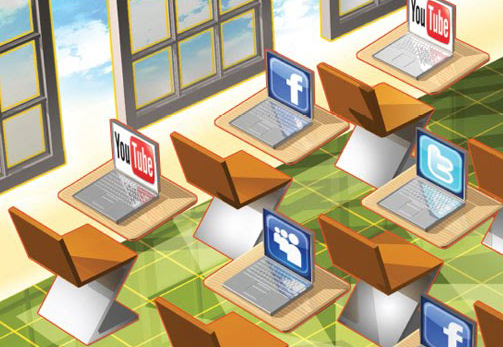
Thinking about my classroom (or lab), what makes it up? It's me and those 24 faces staring at me (or at their smartphones when they think I'm not looking). When they are busily engaged in activity it's still just them....and me.
But occasionally there's little intruders. "The other lab didn't do this activity," " RPH blood transfusion policy doesn't require that...," "you know One direction just landed in Sydney." And this information all came from 'the outside' world. So my opinion now is, if you can't beat them, join them! Social media and technology is in every part of most of our lives now, 80.5% of Australians are internet users (Internet World Stats. Usage and Population Statistics, 2013). It plays a role in how we communicate, seek information, shop and many other facets of our lives.
So why not in learning? Instead of banning smartphones in class, maybe we should embrace them. Isn't that more authentic? Out in the 'real world' professionals access the internet and social media for information exchange, expert advice all the time. So why say no in class? There's always that risk that it will be misused and students will be distracted. But as Caleb Ferguson (2013, 745) points out with view to smart phones in hospital settings, "avenues for idling time away have always been there, but those who work within ethical and clinical standards clearly will not engage in this behaviour." Let's put the ball in their court. You misuse it, you loose it.
Within my practical labs, I encourage the use of devices along with the 'old fashioned' text or lecture notes. If it's going to aid in their learning, I'm all for it. I'd like to even enhance it. Microblogging platform twitter is starting to show a strong presence in research and how people information exchange. A study outlined by Peter Reed (2013) showed students that used twitter for an assessment requiring them to tweet daily on a topic, raise points of concern, offer remedies, also respond to tweets on the original topic/concerns and remedies were far more engaged and offered more discussion points than a control group that were writing journals.
NDU Fremantle Campus Nursing School conducted it's inaugural SMART Care conference (Social Media application for research and teaching) recently. Students there showcased how they have engaged in social media to benefit their learning. And if you were unable to attend the conference, you could follow along on twitter #NPD100. Academics tucked away at universities or nursing experts in their hospital offices are now within reach, exchanging current up to date information with the community the seek to improve. It's an exciting time, not time to put the phone down.

(Social media in education. Is it a good thing? 2012)
References
Ferguson, Caleb. 2013. It's time for the nursing profession to leverage social media. Journal of Advanced Nursing 69 (4): 745-747
Internet World Stats. Usage and Population Statistics, 2013. Accessed Oct 29, http://www.internetworldstats.com/stats.htm
Reed, Peter. 2013. Hashtags and retweets: using Twitter to aid Community,Communication and Casual (informal) learning. Research in Learning Technology 21 :19692 - http://dx.doi.org/10.3402/rlt.v21i0.19692 Social Media in education is. Is it a good thing? 2012. http://www.iptv.org/medialib/graphics/ed_20120308_socialmedia_classroom.jpg

Tips on Collegiate Student Blogging. 2012. http://profalbrecht.files.wordpress.com/2012/08/social_media_classroom.jpg
Sunday, 29 September 2013
Flippin' awesome


So previously I looked at "The lecture as we know it is dead..." So what can we do to either revive it, or maybe...turn it on it's head?
Talk of "The Flipped Classroom" has gained lots of momentum over the past few years. There's no definition or exact example of the flipped classroom, but more the idea and intent behind it.
It's about spending that valuable teaching time, engaging students in activity that provoke higher learning, give context to content and allow immediacy to the feedback that students require. Instead of being at home wondering if they are on the right path, they have their expert right there in class to discuss answers, ideas and issues with. Not only do they have you (or me) the expert there, they have their fellow students to collaborate with, learn from and return the favour of passing on their knowledge to fellow students. You know what they say... the best way to learn is to teach (see the learning pyramid in my last blog).
So, where's the content gone? This is the other part of the flip. The students are gaining the content (previously the didactic lecture) in their own time and before class. Whether it be the lecture now via podcast or YouTube for example. Or maybe a series of small lectures so the content is broken down into sections. Perhaps they can wonder through a prezi taking in small parts of the content at a time. Salam Khan (2011) gives an interesting TED talk on flipped classrooms and discussed how his audience (nephews) preferred the online version of him, than tutoring them 'in real life.' No offence was intended. They just liked that they could pause him, rewind him, review something and then move on. Food for thought or Flip for thought if you like a pun.
Research into the flipped classroom shows positive outcomes. Holland and Morra discussed how Clinton Dale High school in the United States flipped some classrooms. The outcomes had the fail rate for English drop from 50% to 19%.
Is it for everyone? As Spencer et al (2011) outlines, you need to review your end goal, and see if you have or can create the resources you need to ensure they get you (or more importantly your students) to that end goal. And it's not the pinnacle, you cant just say you've flipped your classroom and roll out the same 'flip' each semester. You still need to review, evaluate and revise your plan to ensure the student outcomes are met. As Sams says, "your flip needs to be in flux. (Sams, 2011)"
Now of course there's cons...there's always some cons. Maybe I'll do a prezi on it, you can have a read and then well discuss it ?
Berrett, D. "How 'flipping' the Classroom Can Improve the Traditional Lecture. 2012. The Chronicle of Higher Education. February 19. http://moodle.technion.ac.il/file.php/1298/Announce/How_Flipping_the_Classroom_Can_Improve_the_Traditional_Lecture.pdf
Holland, B and Morra, S. 20135 Flipped Classroom Issues (And Solutions) For Teachers. Accessed 23 September. http://www.edudemic.com/flipped-classroom-issues-solutions/
Khan,Salman. 2011 : Let's use video to reinvent education. TEDtalks video. 20:27
http://www.ted.com/talks/salman_khan_let_s_use_video_to_reinvent_education.htmlSams, A. "Setting The Flip Straight". 2011. The Daily Riff November 11. http://www.thedailyriff.com/articles/the-flipped-class-shedding-light-on-the-confusion-critique-and-hype-801.php
Spencer,D., Wolf, D. and Sams A. " Are you ready to Flip?". 2011. The Daily Riff June 22.
Thursday, 12 September 2013
The lecture as we know it is dead...
As I’ve been thinking about
learning of late and trying to define my thoughts, a quote I read recently has stuck
with me. “Learning
is not a spectator sport. (Meier, 2013)”
Potentially the old
fashioned lecture is on its way out. I
feel face to face lecturing is important, but by marrying it with the
constructivist pedagogical emphasis of active learning we can enhance its effectiveness. Utecht (2012 )presents interesting thoughts on lectures which I have to
agree. By using it less for content
delivery, and more to inspire and push ideas.
He has suggestions on making students seek the content. Really he’s making ‘pre-reading’ active and
collaborative.

Image from Soft Star Research Inc
TED ideas worth sharing. 2013. TED conferences LCC. Accessed September 6, http://www.ted.com/talks
Utecht, Jeff. 2012, July 12. "Lecture As Content Delivery Is Dead." The Thinking Stick Blog http://www.thethinkingstick.com/lecture-as-content-delivery-is-dead/
Subscribe to:
Posts (Atom)